Story
When Speakers Shut Doors to the Press
State House Speaker Jason White's decision to bar Mississippi Today's access to his office is reminiscent of President Trump's indefinite ban of the Associated Press from his environs. Perhaps that's...
State House Speaker Jason White's decision to bar Mississippi Today's access to his office is reminiscent of President Trump's indefinite ban of the Associated Press from his environs. Perhaps that's where he got the idea.
This is a ridiculous and rare event in media coverage of the Mississippi Legislature. I cannot recall a House speaker of recent times throwing such a tantrum.
When I worked as a Capitol reporter and later as media liaison for esteemed Speakers Tim Ford and Billy McCoy in the early 2000's, they might grumble over news coverage, but they never held a petty grudge and instituted an access ban.
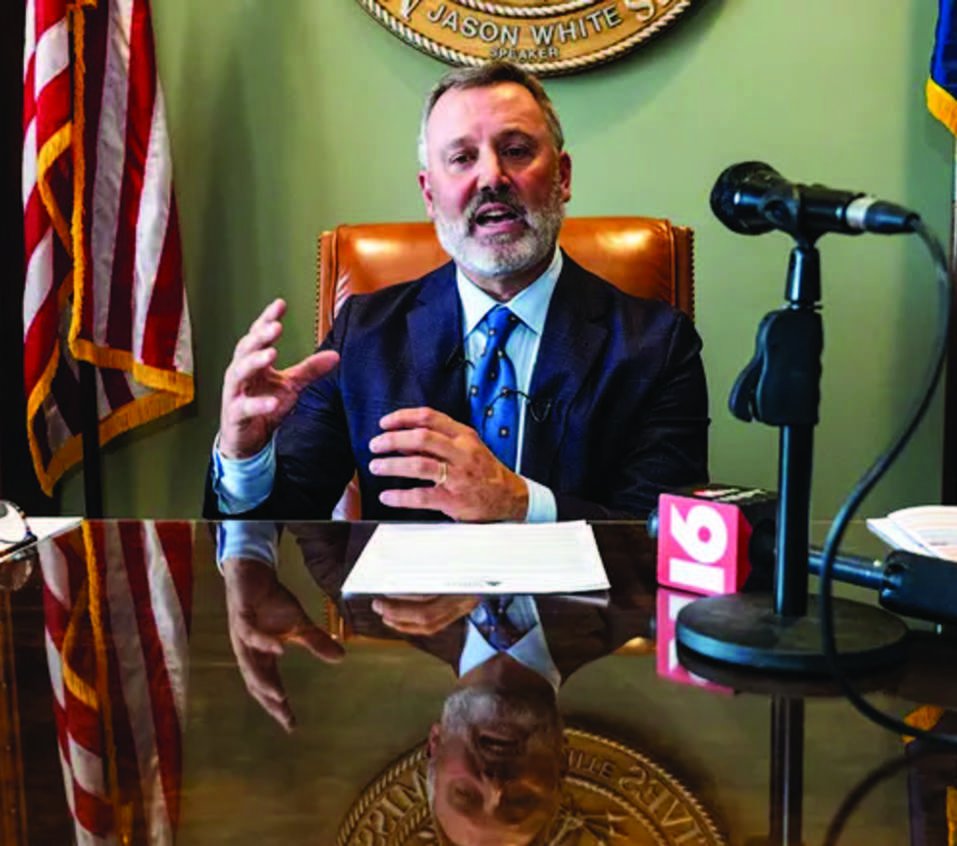
White, a Republican from West Holmes County, became speaker in 2024. He recently barred Mississippi Today reporters from a discussion of legislative issues. White was reportedly upset over the online publication's coverage of his trip to the 2025 Super Bowl.
Mississippi Today had reported that some of the trip's expenses were allegedly paid for by a company pushing online sports betting, a perennial issue in this state that ranks 11th in the U.S. for gambling revenue per-capita.
At this writing, as the 2026 session entered its second week, Speaker White had not relaxed the ban he initiated on Mississippi Today's reporters. It wasn't known how long it would last.
Trump's ban on the Associated Press' access to the Oval Office, Air Force One and his Mar-a-Lago resort in Florida also remains largely intact, as AP attempts to reverse the ban. The President instituted it over the AP's refusal to use "Gulf of America" in reports about the more common Gulf of Mexico.
Despite its longevity in the reporting business, I've often wondered how many newswatchers fully understand the AP's role in the industry.
The Associated Press gathers news worldwide for distribution to newspapers and radio and television networks on a fee basis. Many Americans likely recognize the AP for its celebrated "Top 25" polls on college athletics than for any other reason. It does far more serious work, however, than rating college sports teams. The Associated Press is a not-for-profit cooperative, supplying non-partisan, straight-as-an-arrow news gathering to its member-subscribers.
The AP was established in 1846. It once had a fierce competitor known as United Press International, which operated from 1907-1999 when it was scaled back to serve only small-market units.
I worked for newspapers that subscribed to either the AP or UPI. They were equally competent in their news-gathering services.
I had one "national scoop" for UPI in my job as sports editor of the Meridian Star in the 1970's, breaking the news that manager Eddie Stanky was leaving the Texas Rangers pro baseball team to return as head coach at the University of South Alabama. When I sent this news up to UPI headquarters in New York, the national editors were admittedly queasy over my knowing this in Meridian, while they didn't know it in New York. Stanky was soon back in Mobile.
Reporting on a "straight" news line has always been the AP's trademark. That's whether it was covering college football or worldwide politics.
When most think of "AP" in Mississippi, reporters like Jim Saggus, Ron Harrist, Leroy Morganti, Robert Shaw, Robert Naylor, Jack Elliott, Hank Downey, Ralph Russo, Sheila Byrd and the recently-retired Emily Wagster-Pettus come to mind--and the long-defunct Jackson UPI's Andy Reese, Louis Lord, Bessie Ford, James Lee Jones, Elaine Povich, Phil Hearn, Rheta Johnson and Billy James.
Wagster-Pettus, who also covered politics for The Clarion Ledger, didn't retire for long. She's now a top editor at Mississippi Today and on Jan. 7 wrote an article lamenting Speaker White's ban.
---Mac Gordon is a native of McComb. He is a retired newspaperman. He can be reached at macmarygordon@gmail.com.